Kai 1: Decisions, Not Completions
Kai is Hanzo's decision model, served by the Hanzo API. Give it explicit state and a listed question, and it returns a typed, calibrated answer — a choice, a score, a yes/no, or a reasoned deferral.

Antje Worring
antjeworring.com ↗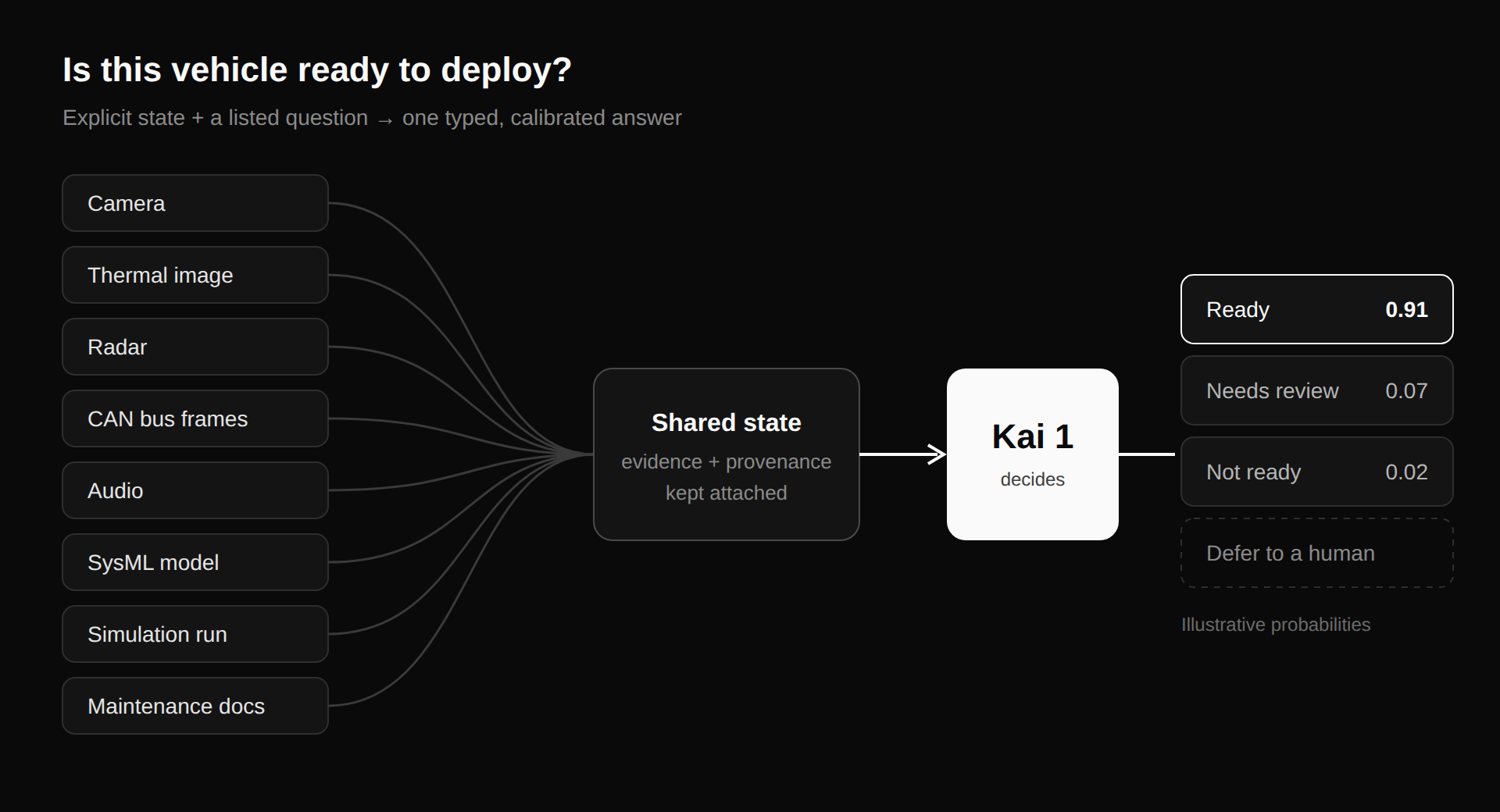
Most steps in production software don't need a paragraph. They need an answer the software can act on: which tool to call, whether the evidence is enough, how severe a risk is, whether a human must sign off.
Today we're introducing Kai 1, Hanzo's decision model. Give Kai the facts of a situation and a question with listed options. It returns a typed answer (a choice, a score, a yes/no, or a calibrated "not sure, defer") with a probability for every option.
Kai 1 is live on the Hanzo API. Its weights are closed: Kai is served by API only.

Language models reason. Kai decides.
When you ask a language model to make a call, you get text back. You have to parse it, trust a confidence number the model made up, and hope the output stays in bounds.
Kai is built for the steps where that isn't good enough. Its answers are bounded, its probabilities are calibrated, and there's nothing to parse. Every Kai answer is one of four types:
- Choice: one option from a listed set, with a probability for each
- Score: a rating against levels you define
- Predicate: a yes/no with its probability
- Defer: Kai isn't confident enough and hands the call to a person or a rule
Evidence stays attached
A decision shouldn't care whether its evidence started as text, an image or a sensor reading. Kai is designed to take mixed evidence and keep its origin attached to every answer.
A number without provenance is just a number.

Many decisions, one pass
Agent loops ask one question at a time. Kai is designed to run a whole decision program at once: one shared state, many decisions, with dependencies spelled out. Confident answers are locked in first, and only the uncertain ones get more work.
The goal is that a program with thousands of decisions shouldn't need thousands of serial model calls.

Every decision can be replayed
Each Kai decision records the program version, evidence fingerprints, model revision, full probability distribution, approvals and execution trace. When someone asks why the system did something, you can show them.

Where Kai fits
- Agents: model and tool selection, when to continue or stop, when to ask a human
- Business workflows: lead scoring, intent detection, next best action, escalation
- Physical systems: vehicles, robotics, manufacturing, energy and infrastructure, where decisions run on sensor data
Part of the Hanzo stack

Generation and decision are different jobs. Zen6 is our family of open-weight generation models. Kai 1 makes bounded, calibrated decisions. Enso routes each task to the one it needs.
Where it runs
Kai runs on the Hanzo API, at POST https://api.hanzo.ai/v1/decisions, for $0.021 per million input tokens with output free. Its weights are not published, and it is not offered for self-hosting.
What's next
We're working on seven open research questions, and we'll publish results only once they can be reproduced:
- Decisions over extremely large option sets
- Multilingual decisions
- Shared-state decoding
- Decision diffusion (refining only uncertain answers)
- Multimodal evidence
- Calibration and knowing when to abstain
- Consistency across connected decisions
Kai 1's first results are published. On the 12 headline suites of a frozen decision harness, Kai 1 averages 85.7% accuracy against Jev's 78.0%. It is more accurate on 11 of 12 suites, behind on jailbreak (91.75% against 94.0%), and its calibration error is lower on 8 of 12. Those runs were measured on CUDA; production answers on CPU. Kai 1 is not yet competitive on dependent multi-question programs, on negated yes/no questions, at 150 or more options, or on calibration for typed decisions and jailbreak, and at 1,000 or more options its accuracy is near zero. Every table, with the run each number comes from: hanzo.ai/kai and the Kai docs.
Stop asking one model to do everything
Call Kai through the Hanzo API today.
Read more
What Is a Decision Model?
Generative models reason in unconstrained paragraphs. Decision models decide in typed, calibrated state transitions. Here is why the next frontier of AI is not generation, but decisions.

Top Pain Points for Investment Firms That Hanzo AI Solves
Identify key operational challenges in private equity, venture capital, and asset management — and discover how Hanzo's sovereign AI cloud, frontier reasoning models, and agentic workflows streamline sourcing, diligence, and execution.
The router is the registry
Hanzo Cloud has no checked-in OpenAPI file. The live route table is the source, projected three ways, and a bijection test fails the build if any projection drifts. 1,362 operations across 963 paths, generated per process at request time.